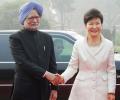
South Korean President Park Geun-hye's visit to India will enhance economic and military ties between the two countries and give the relationship a strategic dimension, says Jiye Kim.

Terrorism and Afghanistan were the focus points of Prime Minister Narendra Modi's talks with Uzbek President Islam Karimov on his first visit to Central Asia.
'Modi and Abe are working seriously for India-Japan bonhomie to grow stronger.' 'It is a win-win situation for both countries and the future look promising,' says Rajaram Panda, the Indian Council for Cultural Relations India Chair Visiting Professor at Reitaku University, Japan.

Soaked in patriotism, hundreds of Indians on Monday proudly marked the country's 70th Independence Day, as the tricolour fluttered and the national anthem reverberated at Indian missions across the world.

Girls in the Kashmir valley hurling defiance at the security forces will detract from the legitimacy of India's response and its standing in the world, says Ajai Shukla.

His view will be shaped by his perception of US world interests and India's economic performance relative to China.
China's Vice Foreign Minister Li Baodong again harped on the need to build consensus over the admission of new members in the 48-member Nuclear Suppliers Group.

'Ensuring through diplomatic means and in conjunction with strategic partners that India will not be required to fight a simultaneous two-front war with China and Pakistan.' Brigadier Gurmeet Kanwal (retd) lists what India must have in its national security strategy.
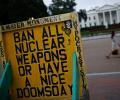
After 20 months of hectic negotiations, Iran and six major powers have reached a historic deal to limit Teheran's nuclear programme in return for lifting of sanctions. Let's understand closely what the deal is all about.

'The past year has yielded extraordinary results in the strategic, commercial, and people-to-people components of the India-United States partnership, US Ambassador to India Richard Rahul Verma tells Aziz Haniffa/Rediff.com in an exclusive interview.

Macron accepted the invitation and said he will visit New Delhi by the end of the year for an international summit on solar power - an area on which France plans closer cooperation with India.

At the same time China said that it does not mean China should "appease" India to prevent it from playing "little tricks".

The PM added that developing the infrastructure in the north-east region is being given top priority by the government.

'Ahmedabad-Mumbai bullet train will not begin to address any of the many problems Indian Railways faces.'

The joint statement issued after Prime Minister Narendra Modi and President Barack Obama's first-ever summit is high on intent and ambition. Notably missing from the statement is India's refusal to be America's partner in its war against ISIS.

'Let me talk about young Indian startups with their hearts in the right place and how they are proving that innovations that represent 'affordable excellence' -- breaking the myth that 'affordability' and 'excellence' cannot go together -- is indeed possible!' says Dr R A Mashelkar, the eminent scientist, in this fascinating feature.

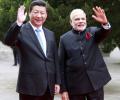
Xi and Modi met soon after their arrival at a summit of the BRICS group of emerging powers. Xi said the two countries should join hands in setting global rules and suggested he attend the November meeting of the 21-nation APEC in Beijing, as well as take part in Chinese-led regional initiatives.

This is the joint statement issued by the ministry of external affairs on the visit of US President Barack Obama to India.

New Delhi and Beijing are the only two regional capitals that have commented on US President Donald Trump's speech on August 21 outlining the way forward in Afghanistan. The Indian foreign ministry statement was effusive in praise, while the Chinese statement has been one of cautious and guarded hope. Delhi has identified itself with Trump's Afghan strategy, whereas the Chinese stance is calibrated -- observant and objective, keeping a distance, says Ambassador M K Bhadrakumar.

Modi also made a call for European Union unity and said India would play a positive role in enhancing that through Germany.

'This is the first time that the Americans have agreed to refer to "cross-border terrorist attacks" in a joint statement.' 'No wonder Pakistan has called the joint statement "singularly unhelpful" and has blasted it, and its all-weather friend China has applauded Pakistan's frontline role in combating terrorism,' points out former foreign secretary Ambassador Kanwal Sibal.

'Most of the agitations are staged by the Opposition to disturb the peace of the state.'

There are signs of China's external behaviour becoming more aggressive in the coming years. If that happens, strategic implications for neighbours having territorial disputes with China can become deeper and imperatives can rise for the former to counteract, says D S Rajan

'The middle class is already alienated.' 'If the stockmarket is destabilised, the BJP is finished; the party will lose in every town.' 'And if the stockmarket crash happens now, the BJP will not cross the 150 mark in 2019.'
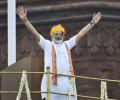
Following is the full text of Prime Minister Narendra Modi's address from the ramparts of the Red Fort on the 73rd Independence Day.
Among others, China is developing the strategically located Gwadar port in Balochistan, which is aimed towards having a military presence, says a Pentagon report
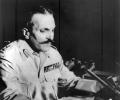
29 years ago this August, Pakistan's dictator, the general who made jihad part of Pakistani State policy, died in a mysterious air crash. Did the KGB, the then USSR's dreaded espionage agency, assassinate Zia-ul Haq? Was India's RA&W responsible for blowing Zia's military aircraft out of the skies? Was it Zia's many enemies in Pakistan's military? Was it a box of mangoes as Mohammad Hanif speculated in his fascinating novel about Zia's death? Or was the assassin someone else?
29 years ago this August, Pakistan's dictator, the general who made jihad part of Pakistani State policy, died in a mysterious air crash. Did the KGB, the then USSR's dreaded espionage agency, assassinate Zia-ul Haq? Was India's RA&W responsible for blowing Zia's military aircraft out of the skies? Was it Zia's many enemies in Pakistan's military? Was it a box of mangoes as Mohammad Hanif speculated in his fascinating novel about Zia's death? Or was the assassin someone else?
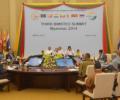
Leaders from the seven-nation Bay of Bengal Initiative for Multi-Sectoral Technical and Economic Cooperation on Tuesday vowed to jointly combat the growing threat of terrorism, transnational crimes and drug trafficking and agreed to intensify efforts to enhance connectivity and cooperation in areas like trade, energy and environment.
29 years ago this August, Pakistan's dictator, the general who made jihad part of Pakistani State policy, died in a mysterious air crash. Did the KGB, the then USSR's dreaded espionage agency, assassinate Zia-ul Haq? Was India's RA&W responsible for blowing Zia's military aircraft out of the skies? Was it Zia's many enemies in Pakistan's military? Was it a box of mangoes as Mohammad Hanif speculated in his fascinating novel about Zia's death? Or was the assassin someone else?
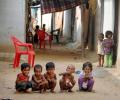
Rohingyas settled in Jammu tells how they are facing a battle for survival
'It's the first-ever US presidential visit which is specially planned for India.' 'The standalone visit itself has achieved something already. Don't underestimate it.' Sheela Bhatt gives us an exclusive glimpse of what the Modi government hopes to achieve from Trump's visit.
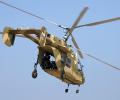
So keen is Moscow that India buy its helicopter -- Kamov-226T -- that President Vladimir Putin personally took up the issue with PM Narendra Modi during their summit meeting last year

The Security Council as it is today is unable to bring peace and security in the world and so there is reason for countries like India to become members of the Council, Ambassador Asoke Kumar Mukerji tells Sheela Bhatt/Rediff.com.

The Russians had appealed their exclusion from the Games by the International Olympic Committee (IOC) over the doping scandal from the 2014 Sochi Games.

'If the nub of India's sensitivity over the Chinese presence in Doklam is the enhanced threat to the Siliguri Corridor, a vital link to the northeast, does it serve the national purpose to have the districts along it, and then much of the tribal northeast, in turmoil?' asks Shekhar Gupta.

At least 56 seminaries and facilities being run by JuD and its wing FIF in Pakistan's southern Sindh province have been taken over by authorities.

'The military aim in a future conflict, if it can't be avoided, should be to cause maximum damage to the adversary's war waging capability and capture limited amount of territory as a bargaining counter,' says Brigadier Gurmeet Kanwal (retd).

Khan's government will be the third consecutive democratic government in Pakistan since 2008.

President Obama had no intention of risking a global conflagration on account of the use of chemical weapons in Syria, especially at a time when he was struggling to wind up the wars his predecessor had started, says T P Sreenivasan
 © 2026 Rediff.com - Advertise with us - Disclaimer - Privacy Policy - Sitemap - Feedback - About us - Terms of use - Grievances